


Mazda CX-30 Active Edition Review: The Base Model That Doesn't Feel Basic


My relationship with Mazda goes back long before I started reviewing cars. Growing up, my dad owned a Mazda 626 before later moving into a Mazda B2500 Eagle. Neither ever gave him any problems, which helped build a positive impression of the brand from an early age.
During my time reviewing cars, my experience with Mazda has been limited to the CX-60 range. The CX-30 Active Edition therefore represented something different. Not only was it my first time driving Mazda's compact crossover, but it was also the least expensive vehicle I had reviewed from the brand.

Finished in Mazda's stunning Soul Red Crystal paintwork, it certainly made a strong first impression when it arrived. Mazda has long been known for producing some of the best red paint finishes in the industry, and the CX-30 wears it exceptionally well.
If I'm honest, I wasn't expecting much. This was the entry-level Active Edition, after all, and arguably the least special vehicle I had reviewed in quite some time. Coming from multiple CX-60s, I expected a competent crossover, but not one that would leave much of an impression.
Over the following week, however, the CX-30 would prove there is far more to Mazda's smallest SUV than its position in the range might suggest.
Exterior: Design That Refuses to Age

A Mazda is a Mazda. What I mean by that is if you were to remove every badge from the CX-30, you would still immediately know it was a Mazda. The brand has built a very distinct design language over the years and, thankfully, it hasn't felt the need to chase trends or reinvent itself every few years.
That is not a criticism. In fact, it is one of Mazda's strengths.
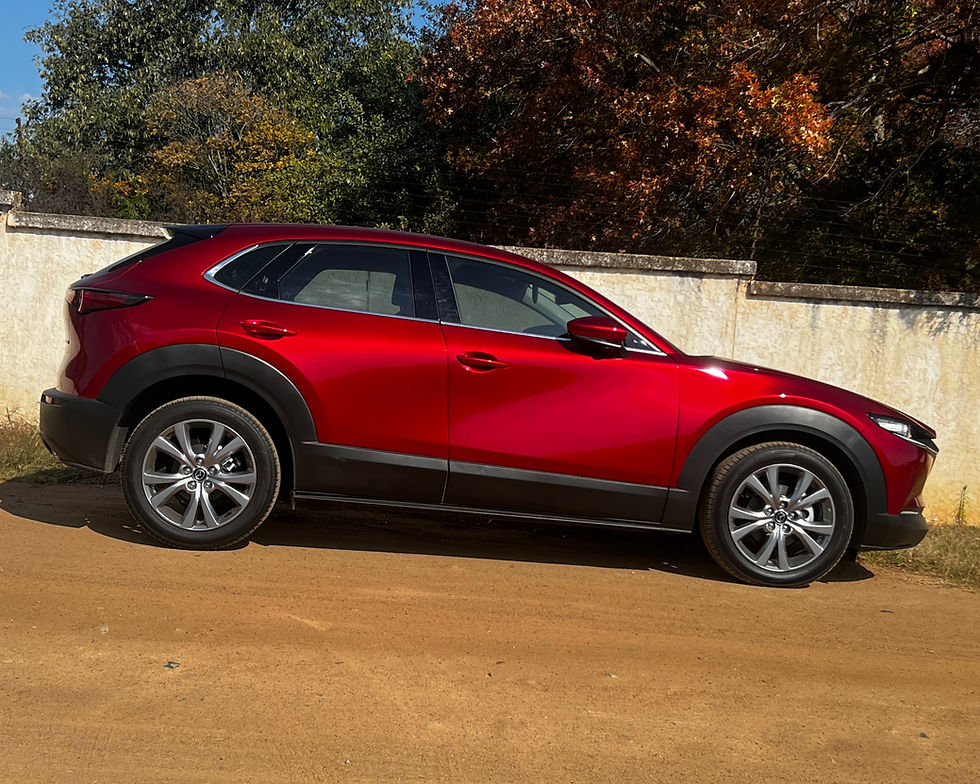
The CX-30 carries the same understated yet graceful design that has become synonymous with the brand. It is clean, elegant and free from unnecessary styling gimmicks. At the same time, it brings a slightly more adventurous character than some of Mazda's other offerings. The raised ride height and generous plastic cladding suggest this is a vehicle that would not mind venturing beyond the tarmac, even if most owners will likely spend their time in the city.
Of course, much of the credit has to go to the Soul Red Crystal paintwork. Mazda simply makes one of the best reds in the business. Under direct sunlight, the colour comes alive in a way that few rivals can match, highlighting every curve and contour of the bodywork.

My test vehicle was the entry-level Active Edition, which means it misses out on the black 18-inch alloy wheels fitted to higher-spec models and instead makes do with 16-inch grey metallic alloys. Yet I never found myself wishing for the larger wheels. The CX-30 remains a handsome vehicle regardless of trim level, proving that good design does not depend on oversized wheels.

There are also details that I particularly appreciated. The twin exhaust outlets are fully functional with no fake trim pieces in sight, something that is becoming increasingly rare in modern cars. Around the back, the slim rear light design works beautifully with the Soul Red Crystal paint. In certain lighting conditions, the rear three-quarter view is surprisingly exotic.

In fact, and I know this sounds ridiculous, there were moments when the combination of the rear lights and that red paint made the CX-30 look a little bit like a Ferrari. Yes, I said it.
Interior: Quality Beyond Expectations
If there is one area where the CX-30 punches above its weight, it is the interior.

For an entry-level car, it is surprisingly easy to forget that you're sitting in the most affordable version of the range. Yes, the Active Edition comes with cloth seats rather than leather upholstery, but they are comfortable and supportive enough that I never found myself wishing for anything more during my time with the car.

What I have always admired about Mazda is its refusal to cut corners where it matters. While some rivals fill their entry-level cabins with hard, scratchy plastics, Mazda takes a different approach. The materials throughout the CX-30 feel well considered, from the leather-wrapped steering wheel and gear selector to the dashboard and door panels. You are constantly interacting with surfaces that feel pleasant to the touch, which elevates the experience far beyond what you might expect at this price point.
The cabin layout itself is simple and intuitive, avoiding the temptation to overwhelm occupants with unnecessary design flourishes. Everything feels solidly put together and there is a sense of quality that has become increasingly rare in this segment.

Space in the rear is respectable too. While this is very much a compact crossover, passengers are not left feeling cramped and the rear center rest with integrated cupholders adds a welcome touch of practicality. Together with the cupholders up front, the CX-30 offers enough everyday convenience for family duties, commuting and weekend errands alike.
It may not be the most spacious vehicle in its class, nor does it try to dazzle with extravagant luxury. Instead, the CX-30 focuses on getting the fundamentals right. Comfortable seats, quality materials and a well-executed cabin make it a genuinely pleasant place to spend time, which is ultimately what matters most.
Tech & Features: Mazda Doesn't Believe in Bare Bones
One thing that makes you question whether this is really a base-spec model is the technology on offer.

Mazda has taken the approach of including the features people actually use every day rather than holding them back for more expensive derivatives. As standard, the CX-30 Active Edition comes equipped with wireless Apple CarPlay and Android Auto, a wireless charging pad and four USB-C ports, with two up front and two for rear passengers.
The technology highlight, however, is the Head-Up Display. It remains a feature that is absent from some premium German vehicles, yet Mazda includes it as standard on its entry-level crossover. Once you've spent a few days with it, having key driving information projected directly into your line of sight quickly becomes something you miss when it's gone.
The 10.25-inch infotainment display is neatly integrated into the dashboard rather than being awkwardly perched on top of it. Mazda's approach to usability is slightly different from most manufacturers. While the screen functions as a touchscreen when stationary, inputs are handled through the rotary commander dial once the vehicle is moving. It might sound unusual at first, but it quickly becomes second nature and, in some situations, can actually be less distracting than repeatedly reaching for a touchscreen.
Ahead of the driver sits a digital instrument cluster that offers a degree of customisation, helping modernise the cabin without becoming overly complicated. Everyday conveniences such as a reverse camera and front and rear parking sensors further add to the feeling that very little has been sacrificed despite this being the most affordable CX-30 in the range.
All things considered, Mazda does not cheap out when it comes to technology. The CX-30 Active Edition may sit at the bottom of the range, but it still delivers all the features most buyers are likely to want and use on a daily basis.
Performance & Drive: Naturally Aspirated, Naturally Enjoyable
One thing I immediately appreciated about the CX-30 is Mazda's commitment to a proper 2.0-litre naturally aspirated engine. In a market increasingly filled with small-capacity turbocharged engines, particularly from newer Chinese competitors, there is something refreshing about an engine that relies on displacement rather than forced induction.

The 2.0-litre petrol engine produces 162hp (121kW) and 213Nm, figures that may not sound particularly exciting on paper but are delivered in a way that feels well judged. Having previously driven both the 3.3-litre diesel CX-60 Takumi and the 2.0-litre CX-60 Individual, I already knew Mazda understands engine calibration better than most. The CX-30 only reinforced that impression.
Select Sport mode and the character of the car changes noticeably. It becomes more eager to respond and reveals a playful side that you might not expect from a compact family crossover. No, it is not a hot hatch, but there is enough enthusiasm in the powertrain to make a spirited drive genuinely enjoyable.
The ride quality sits on the firmer side of the spectrum, which complements the car's handling and overall sense of engagement. The trade-off, however, is that there are moments when you wish for a little more compliance from a vehicle that will spend most of its life tackling daily commutes and urban roads. Whether that is a positive or negative will largely depend on what you value in a crossover.
Another area where my experience differed from the brochure was fuel consumption. Mazda claims a combined figure of 6.6L/100km, but throughout my time with the vehicle I never came close to matching that number. The lowest figure I managed to achieve was 8.3L/100km, which is respectable enough but still some distance from the official claim.
One feature I did appreciate was the adaptive range calculation. The vehicle arrived showing approximately 400km of remaining range, yet by the third day that figure had climbed to around 470km as the system adapted to my driving style. It is a small detail, but one that gives a more realistic picture of what owners can expect from a tank of fuel.
There is also a surprisingly enjoyable soundtrack from the exhaust once you're on the move. It is not loud or intrusive, but it adds a welcome touch of character to an engine that could otherwise have been purely functional.
My biggest takeaway after a week with the CX-30 is that Mazda remains one of the best in the business when it comes to calibration and tuning. The fundamentals are all there. The engine, transmission and overall driving experience work together beautifully. If there is one area I would like to see improved, it would be fuel consumption, which never quite lived up to the numbers on the spec sheet.
Price & Verdict

This is where things become a little complicated for the CX-30 Active Edition.
At R539,000, there are simply too many alternatives competing for your attention. The Chinese manufacturers have changed the landscape dramatically and buyers now have access to vehicles that offer more space, more features and, in some cases, better value for money.
Take the MG HS for example. Starting at around R499,000, it presents a stronger overall package on paper and undercuts the Mazda by a significant margin. Then there is the growing number of electric vehicles entering the market. Given my real-world fuel consumption of 8.3L/100km, you could make a compelling argument for something like the BYD Surf if your driving consists primarily of urban commuting. It is becoming increasingly difficult to ignore the benefits of going electric.
That's not to say the CX-30 is a bad vehicle. Far from it.

In fact, this review has highlighted exactly why Mazda continues to enjoy such a loyal following. The design is timeless, the interior feels far more premium than its price tag suggests, the technology offering is generous and the driving experience is typically Mazda. Everything feels thoughtfully engineered and beautifully calibrated.
The challenge is not whether the CX-30 is good. The challenge is whether it is good enough at this price.
I have a genuine soft spot for Mazda. The CX-60 Takumi remains the best vehicle I have driven to date and one that I can recommend without hesitation. The CX-30 Active Edition, however, is a more difficult proposition. Understandably so, this is the entry point into the range and Mazda has equipped it with far more features than you would normally expect from a base-spec model. That inevitably comes at a cost.
If you do decide to buy one, I have little doubt that you will enjoy living with it. It is comfortable, well built, packed with useful technology and genuinely pleasant to drive. The issue is that there are now several alternatives that make a stronger value argument.
The CX-30 remains a very good car. It is just no longer the obvious choice it might once have been.
Final Scorecard: 6.8/10
Category | Rating out of 10 | Notes |
Design | 7 | Elegant and unmistakably Mazda, with Soul Red Crystal paintwork doing much of the heavy lifting. The CX-30 remains handsome, but its styling is beginning to show its age against newer rivals. |
Performance | 7 | The naturally aspirated 2.0-litre engine is smooth, responsive and well calibrated. Fuel consumption, however, falls short of Mazda's claims. |
Tech & Features | 10 | Wireless Apple CarPlay and Android Auto, a Head-Up Display, wireless charging and four USB-C ports make this one of the best-equipped base models on the market. |
Drive | 7 | Engaging to drive with a playful side in Sport mode, though the firm ride may not suit everyone looking for a daily commuter. |
Price | 3 | A difficult sell at R539,000 when strong Chinese rivals and emerging EV options offer compelling alternatives for similar or less money. |


