


Why The 5-Minute Rule Works: The Secret To Achieving Your Goals

Updated: Jun 3
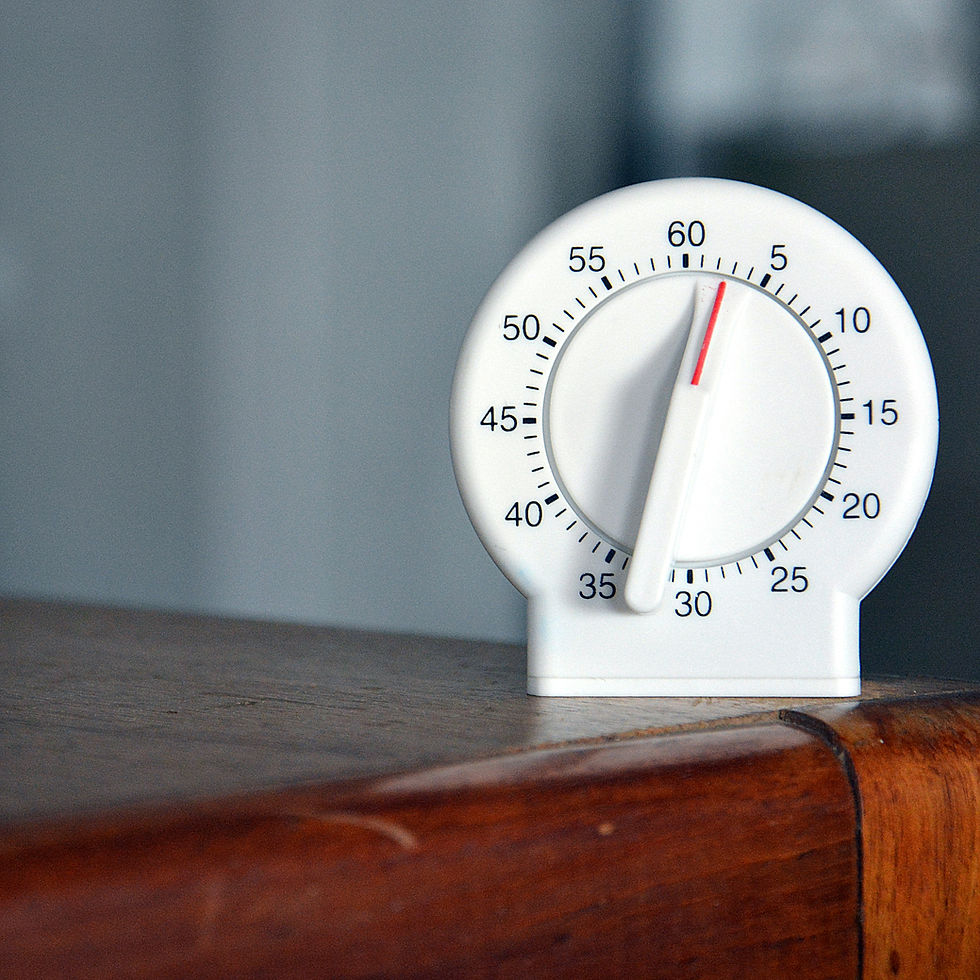
Image Credits: Marcelo Leal, Unsplash
We’ve all been there, that feeling of unwillingness that rushes in whenever a deadline approaches. Whether work, school, exercise or just regular home life chores, there's an invisible feeling of comfort that sneaks in whenever a mentally or physically demanding task needs to be done. Much like a snake, this feeling of unwillingness slowly wraps itself around us, pinning us down to our beds and couches, making us put off our work. This ladies and gentleman is what we call Procrastination.
Procrastination is rarely a reflection of laziness, more often it is an emotional regulation problem. Fuschia Sirois, PhD, a professor with more than 20 years of research in procrastination believes we avoid tasks because our brains anticipate stress, boredom and even failure. Fortunately, there is a simple cognitive backdoor to bypass this mental paralysis, enter The 5-Minute Rule.
What is the Five-Minute Rule: The Power of Micro-Commitments
At its core, the 5-Minute Rule is a self-negotiation technique that states; When facing a task you are dreading, commit to working on it for only five minutes. If after five minutes your mind is still protesting then you can simply stop. No guilt, no failure; the magic of this rule lies in its ability to lower the “activation energy” required to start doing tasks. In most cases procrastination is caused by an overestimation of the misery of doing the task. By shrinking the commitment from “I have to exercise for 60 minutes” or “I have to write a 10-page report” to “I just need to do this for five minutes only,” it evaporates the 90% of work and forces you to deal with the more manageable 10%.
From Cognitive Therapy to Modern Productivity
While the 5-Minute Rule has been popularized by modern productivity influencers like Mel Robbins (who popularized a variation known as “The 5- Second Rule”), its true roots lie within Cognitive Behavioral Therapy (CBT) and early 1970s behavioral psychology.
Psychiatrist Dr. David Burns, in his seminal 1980 book Feeling Good: The New Mood Therapy, introduced the concept of "Do It Yourself," a behavioral task designed to help individuals overcome the feeling of unwillingness associated with depression, anxiety and low mood. Dr. Burns fought against the cultural myth that motivation creates actions. Instead he demonstrated that action precedes motivation. He believes by forcing a tiny amount of action—the core of the 5-Minute Rule—we can stimulate the emotional momentum required to finish.
Beating the Fitness Freeze
Nowhere is this friction of starting more palpable than in fitness. For most of us the thought of intense, sweaty, 60-minute workouts in the morning or evening can trigger an instant mental avoidance. This is where the 5-Minute Rule becomes a game-changer for physical health. Instead of focusing on the entire workout, your only goal should be to put on your gym wear and exercise for 5-Minutes.
Why This Works in Fitness: The Researcher View
Overcoming Stress Forecasting: Humans are notoriously bad at predicting how future events will make them feel. A study by the National Library of Medicine found that people constantly underestimate how much they will enjoy a workout once they actually begin. The 5-Minute Rule forces you past this “unwillingness zone” into the actual experience, where endorphins (feel good chemicals) release into your body and alter your mindset.
Lowering Perceived Exertion: Research regarding behavioral momentum suggests the psychological barrier to exercise is often contained within the transition from rest to movement. A study highlighted by the American Psychological Association (APA) on habit information shows that complex behaviors must be broken down into micro-steps to move past dysfunction. Five minutes of stretching or light jogging not only warms up your muscles but also shuts down the voice telling you stop and relax.
Action is the Antidote
The 5-Minute Rule works because it respects human biology rather than fighting it. It coldly acknowledges that motivation is like an unreliable friend that rarely shows up when needed. By lowering the bar to a manageable level, the 5-Minute Rule transforms a mountain into a hill. Next time you find yourself stuck in a cycle of procrastination, open your phone, set a timer 300 seconds and give yourself the permission to quit. You will be surprised how often you choose to finish.


