


Meet Dr. Avashna Govender: The AI Strategist Empowering Youth, Women & Businesses


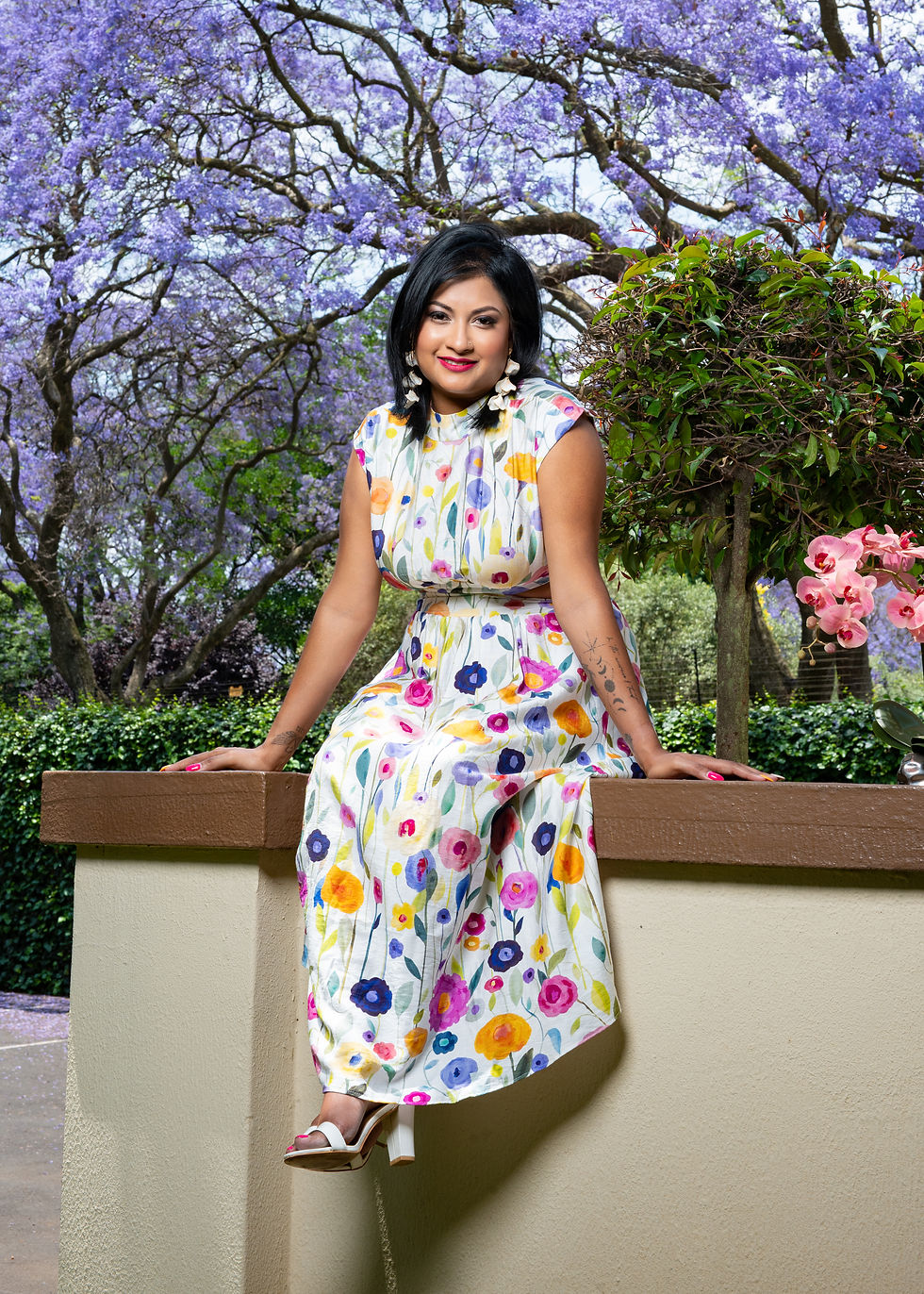
Pick n Pay Clothing Futurewear Collective: Top by Katekani Moreku; Skirt by Yamkela Mahlelehlele | Photographer: Minazel Studio
Dr Avashna Govender is a whirlwind of energy and curiosity. Sitting across from her in a quiet corner at The Salt Road in Houghton, the early morning sunlight spilling across the room, she sips her coffee and speaks as if we have known each other for years. There is a warmth to her confidence, a relentless drive, and a curiosity that felt almost infectious.
Dr Govender is an AI strategist and generative AI research scientist, a speaker, and a coach empowering women, youth, and businesses through AI. Before founding her company, the Innoverse, she served as a research group leader at the Council for Scientific and Industrial Research (CSIR), overseeing 14 engineers across text-to-speech, speech recognition, and natural language processing projects. Today, she splits her time between running the Innoverse, mentoring globally, developing AI-driven platforms, and speaking on the potential of AI across industries.
“I think, for me, it was not really a decision; it found me,” she begins. “From a young age, I wanted to be a paediatrician, but when I hit high school, I realised I couldn’t stand blood. That was when I switched gears and said, okay, I can still help kids, but maybe through science and technology.” She laughs as she remembers her first exposure to coding: “I was part of the first year in my school where Java was introduced. We were the guinea pigs. And once I started, I just fell in love. I’ve always been a problem solver; I was the child who’d take apart every remote-control car my dad bought just to see how it worked.”

The path wasn’t easy, especially in 2006 when coding was still a niche subject in high school. “It wasn’t accessible like it is today. I was a rebel too. My mom wanted me to do accounting, like my sister, but I signed my own forms and applied for computer science and computer engineering at university. I was determined, and I knew I wanted this. I wasn’t scared that it was new.”
Her early projects blended her love for coding with her passion for children. “For my design project during undergrad, I built a Java application to teach children how to read. That’s what set me on the path of speech technology. Back in 2012, this was completely new. I created a system where a child could say ‘cat,’ ‘bat,’ or ‘sat,’ and the application would recognise it and respond with ‘good job, you said it right.’ It was groundbreaking at the time, and I won an award for it.”
She carried this focus into her master’s and eventually her PhD, always thinking about accessibility and inclusivity. “I wanted artificial voices for children, especially those with disabilities, so they could communicate in a voice that felt like theirs, not an adult, American, or British voice. It was about giving children an identity.” At CSIR, her work expanded to African languages, ensuring technology wasn’t limited to English alone. “We built language learning applications in Zulu, Xhosa, and more, to make tech accessible for everyone in South Africa.”
“African languages are severely under-resourced.
I decided to do a PhD because I was bored
There are nuances, accents, and code-switching to account for. It makes the problem much harder than for English. Back then, we used rule-based systems, before deep neural networks came along. Once deep learning arrived around 2015–2017, the field exploded. But it’s still very difficult to do live translation accurately.”

Pick n Pay Clothing Futurewear Collective: Top by Katekani Moreku; Skirt by Yamkela Mahlelehlele | Photographer: Minazel Studio
Her PhD journey was no less intense. “I decided to do a PhD because I was bored,” she says candidly. “I wanted a new challenge. I aimed for an international, world-renowned university. I emailed Edinburgh University, and somehow, through divine intervention, my CV landed on the director of speech technology research’s desk. They encouraged me to apply for a scholarship, and it became the most intense selection process I’ve ever experienced.
Three days in London, activities, tasks, evaluations; like Big Brother but academic. In the end, I was chosen. The PhD itself combined computer science and cognitive science. I studied how humans process artificial speech, measuring pupils to track cognitive effort. Even if you can’t tell the difference between human and AI speech, your brain can.”
Her resilience was tested further when COVID struck. “I contracted COVID in 2021, and I lost 93% of my lung function. I was on a ventilator. It was terrifying, and recovery took months. But I didn’t let it stop me. I managed to finish my PhD remotely by hiring a student to run lab experiments while I guided her via video call”. She submitted her thesis in 2023, and her work was later published at Interspeech, the world’s leading speech technology conference.
She quickly rose to become one of the youngest research group leaders at CSIR, managing an entire research unit like a CEO. “I had 14 engineers reporting to me, and each research group is like a business unit. You manage recruitment, budget, strategy. It was like being a CEO at 31. But I realised, why am I doing this for someone else? That’s when I started the Innoverse.”
“The Innoverse is about empowerment’ youth, women, businesses. AI is a tool for all of that,” she said. Her Amandla Ed platform personalises learning from grade 0 to 12, recommending careers based on strengths and interests. She coaches teens and university students globally, and runs Empower Her to help women use AI to start businesses. “With AI today, you can start a business in less than a month. You can automate tasks, marketing, lead generation. AI can be like a virtual employee. That’s what I want women to know; that they can use AI to gain independence.”

Photographer: Minazel Studio
Her approach extends into tourism and marketing too. “AI can customise adverts for different people in seconds. You can build voices for African languages. For example, you could have an advert in Zulu for one market, Afrikaans for another, French or German for tourists. Hyperpersonalisation is the key. It’s about making people feel VIP, important.”
She also coaches teenagers and university students globally, encouraging them to explore AI research projects, and runs initiatives like Empower Her, a women-focused program on financial independence and AI entrepreneurship. “With AI today, you can literally start a business in less than a month. You can automate tasks, marketing, lead generation; AI can act as a virtual employee. That’s why I focus on empowering women to use AI to their advantage.”
Photographer: Minazel Studio
Even with her packed schedule, she prioritises balance. “I block my time carefully. One day I’ll focus on executive decisions, another on app development. Outside work, I meditate, read nonfiction, and spend time with my two dogs. It’s about feeding my curiosity while giving my brain a rest.”
Avashna’s vision is clear: to make AI inclusive, accessible, and empowering, bridging language and technology gaps, and inspiring the next generation of innovators. Sitting across from her, it’s easy to see how her drive, confidence, and curiosity have shaped her extraordinary journey; from a curious teen dismantling remote-control cars to an AI leader reshaping the landscape for South Africa and beyond.


