


The Galaxy S26 Launch: Innovation in Privacy


Last night, the 25th of February 2026, was the launch of the Samsung Galaxy S26 series. I walked in with tempered expectations. Smartphones feel like they’ve reached a plateau. Cameras are excellent. Displays are sharp. Performance is rarely an issue. Genuine, hardware-led innovation has become incremental rather than transformative.
TM Roh, CEO and Head of the Device eXperience Division at Samsung Electronics, opened the keynote by framing artificial intelligence not as a feature, but as infrastructure.

“Every long-breaking technology follows a similar journey,” he said. “It begins as a marvel, very expensive and then celebrated. But the technologies that change history are something different, because they become infrastructure. AI stands at that moment.”
My expectations were quickly confirmed. This was going to be an AI event.
Roh spoke about AI needing to “work for everyone, everywhere, without expertise or vision”, positioning it as something that should quietly operate in the background rather than demand attention. Galaxy AI would be proactive, adaptive, contextual. It would reduce steps. It would anticipate needs.
But while the rhetoric leaned heavily into agentic AI and ecosystem intelligence, there was one rumour that kept my attention: the teased Privacy Display. If the leaks were true, that would be something genuinely different, and enough to make me lean forward for the rest of the keynote.
The Privacy Display Moment

The AI rhetoric set the tone, but the Privacy Display quickly stole the show.
When the demo began, the room shifted. On screen, two women stood in an elevator. One received a message: “Is she with you? We want to plan a surprise for her.” Both glanced at the phone. Only one could see the message. The other woman saw nothing.
Within seconds, the room lit up; applause, audible “that’s amazing” reactions, genuine surprise. Not just because of the feature itself, but because of how cleverly it was presented. It was relatable. Immediate. Practical.
The Samsung Galaxy S26 Ultra introduces what Samsung calls the industry’s first built-in Privacy Display on a mobile device. Unlike stick-on privacy filters, which dim the screen and distort colour, this is engineered at a pixel level.
As explained during the keynote, traditional displays are designed for the widest possible viewing angles. Standard pixels disperse light broadly so content can be seen from multiple sides. A privacy display requires the opposite: narrowing that light so it reaches only the intended viewer.
Samsung’s solution is what it calls a “Black Matrix”. This architecture controls how light leaves each pixel. When Privacy Display is activated, so-called narrow pixels become the primary light source, restricting visibility from side angles. When the mode is off, both narrow and standard pixels operate together, restoring full viewing angles and brightness.
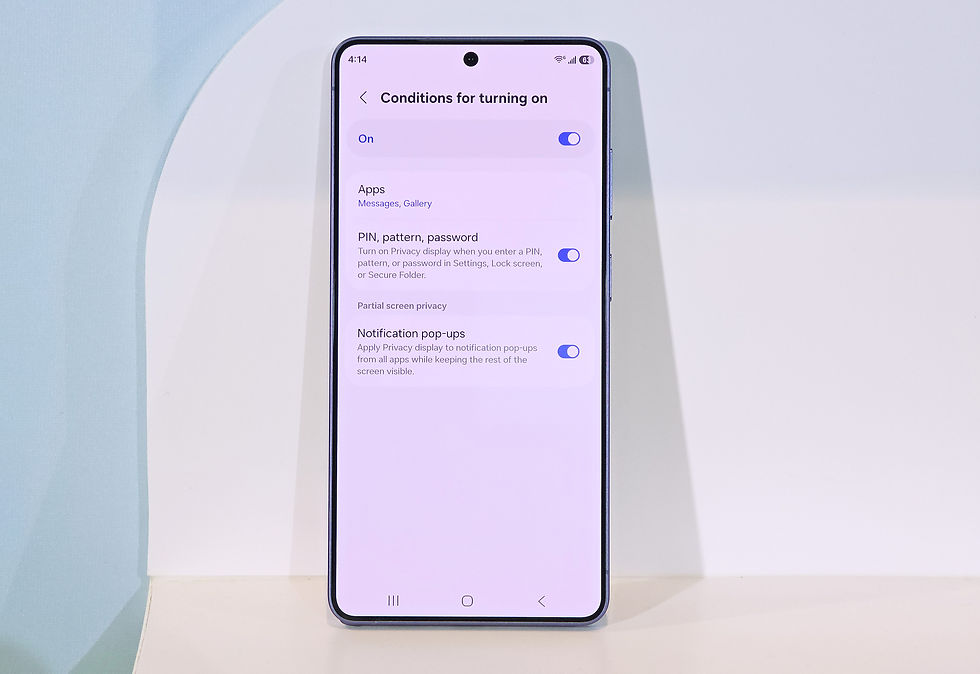
And it’s customisable. Users can set it to activate automatically for specific apps, for PIN entry, or even for certain notifications.
Later, I tested it myself. It works. Standing just off-axis, the screen fades into obscurity. Head-on, it remains crisp and bright. No dimming. No compromise in clarity.
The Performance Behind the Promise

With the applause still settling from the Privacy Display reveal, the keynote shifted into numbers, and lots of them.
The Samsung Galaxy S26 Ultra is powered by a customised Snapdragon 8 Elite Gen 5 for Galaxy processor, designed to handle what Samsung repeatedly framed as “always-on” AI. On paper, the gains are notable: up to 19% faster CPU performance, a 39% boost in NPU capability for AI tasks, and a 24% improvement in GPU output for gaming and heavy visuals.
There’s also a redesigned vapour chamber, Samsung’s largest yet, alongside improved thermal materials to better disperse heat during gaming, multitasking and video capture. Charging sees an upgrade too, with Super-Fast Charging 3.0 pushing the device to 75% in around 30 minutes.
But here’s the reality: these percentages aren’t necessarily for the person upgrading every single year. If you’re moving from last year’s Samsung Galaxy S25, the difference will likely feel refined rather than revolutionary.
Where these incremental gains matter most is for those coming from a Samsung Galaxy S22 or older. Three or four generations of annual improvements compound into something far more noticeable. Apps launch faster. Multitasking feels smoother. Gaming holds steadier. Battery life stretches further.
That’s the reality of modern smartphone evolution. Innovation now happens in layers. Each year adds a little more. It’s only when you zoom out that the leap becomes obvious.
And on the S26 Ultra, that leap is less about raw speed and more about sustaining performance quietly in the background.
The Camera: Software Tidbits

Samsung describes the Samsung Galaxy S26 Ultra as delivering its “best camera system yet”. What became clear during the presentation, however, is that the evolution here leans heavily on software intelligence rather than dramatic hardware reinvention.
Nightography sees further refinement, with improved low-light video designed to retain clarity and vibrancy even in dim scenes; from indoor concerts to late-night outdoor moments. The emphasis wasn’t just brightness, but stability and detail.
Super Steady video has also been upgraded with what Samsung calls a horizontal lock. In simple terms, the phone automatically maintains a level horizon while filming, reducing the need to consciously frame every movement. Whether you’re walking, running or shooting from a moving vehicle, the device aims to correct tilt in real time.
For creators, the addition of APV, a professional-grade video codec, marks a notable step. Designed for high bit rates and near-lossless quality, it allows for 8K recording with greater flexibility in post-production. Footage can be taken directly into editing tools such as DaVinci Resolve or LumaFusion without the kind of compression loss that typically limits smartphone workflows.
Then there’s what Samsung calls Ocean Mode, alongside broader AI-powered enhancements that adjust colour, tone and detail dynamically when shooting underwater content.
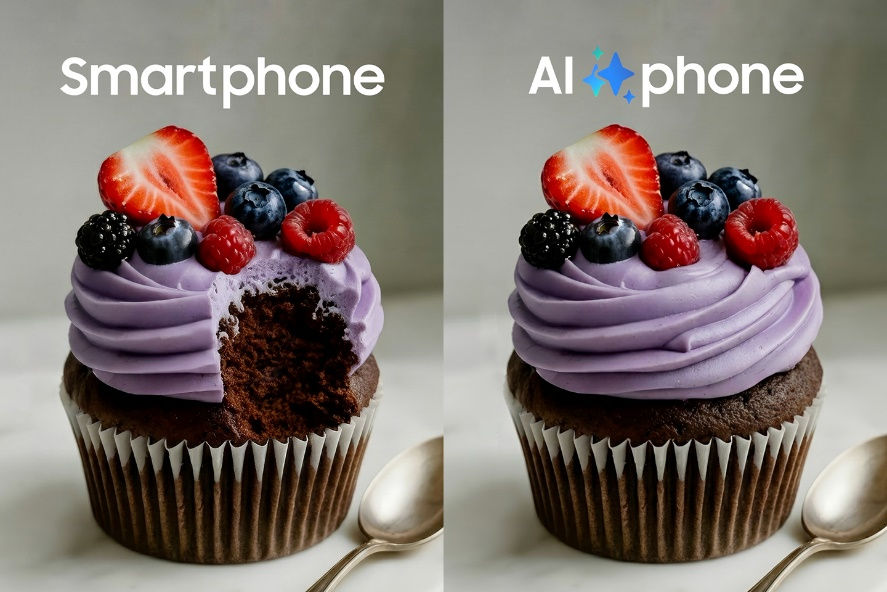
Photo Assist now allows users to describe edits in natural language, adding elements that weren’t originally there, merging subjects from different shots, even restoring missing portions of objects. A half-eaten dessert can be digitally completed. An outfit can be altered. A background can shift from day to night.
There’s also intelligent document scanning built directly into the camera experience, automatically flattening creases, removing fingers from the frame and compiling multiple scans into a single PDF, with no third-party apps required.
More AI
Features like Now Nudge surface contextual suggestions in real time. If a message references an upcoming meeting, the phone can recognise the related calendar entry. If someone asks for trip photos, the Gallery can proactively suggest the relevant images. Now Brief takes that further, compiling personalised summaries and recommendations based on usage patterns.
Circle to Search has also been enhanced to recognise multiple objects within a single frame. Instead of identifying just one item, it can now break down entire outfits; jacket, shoes, accessories, in a single interaction.
Call Screening, powered by AI, summarises unknown callers’ intent before you answer. Meanwhile, users can choose between assistants including Bixby, Gemini and Perplexity, enabling multi-step tasks such as booking transport or coordinating across apps with a single voice request.
On paper, it all sounds seamless.
But here’s the reality: every major smartphone brand is now promising AI that anticipates, organises and simplifies. Many of these features feel helpful in theory. Gmail, for instance, has long suggested calendar entries automatically. Contextual reminders aren’t entirely new.
The real test isn’t whether the technology can do these things, it’s whether people will trust it enough to let it.
There’s a difference between AI offering assistance and users surrendering control of their schedules, messages and workflows. And while the demonstrations worked smoothly on stage, history suggests real-world use is rarely as frictionless as a keynote implies.
That said, the S26’s AI implementation didn’t feel excessive. It felt layered in, but not overwhelming. The features seemed practical enough, even if their long-term adoption remains to be seen.
Samsung’s ambition is clear: AI should fade into the background and operate as infrastructure. Whether users are ready for that level of quiet automation is another question entirely.
Specs and Price
S26 | S26+ | S26 Ultra | |
Display | 6.3-inch FHD+ | 6.7-inch QHD+ | 6.9-inch* QHD+ Dynamic AMOLED 2X Display 120Hz adaptive refresh rate (1~120Hz) Vision booster |
Dimensions & Weight | 71.7 x 149.6 x 7.2mm, 167g | 75.8 x 158.4 x 7.3mm, 190g | 78.1 X 163.6 X 7.9mm, 214g |
Camera | 12MP Ultra-Wide Camera F2.2
50 MP Wide Camera 2x Optical Quality Zoom, F1.8
10MP Telephoto Camera 3x Optical Zoom, F2.4
12MP Front Camera F2.2 | 12MP Ultra-Wide Camera F2.2
50 MP Wide Camera 2x Optical Quality Zoom, F1.8
10MP Telephoto Camera 3x Optical Zoom, F2.4
12MP Front Camera F2.2 | 50MP Ultra-Wide Camera F1.9
200 MP Wide Camera 2x Optical Quality Zoom, F1.4
50MP Telephoto Camera 10x Optical Quality Zoom, 5x Optical Zoom, F2.9
10MP Telephoto Camera 3x Optical Zoom, F2.4
12MP Front Camera F2.2 |
Memory & Storage | 12 + 512GB 12 + 256GB | 12 + 512GB 12 + 256GB | 16GB + 1TB 12 + 512GB 12 + 256GB |
Processor | Exynos 2600 | Exynos 2600 | Snapdragon® 8 Elite Gen 5 for Galaxy |
After all the talk of AI and innovation, it’s worth looking at what actually lands in consumers’ hands, and at what cost.
The Samsung Galaxy S26 arrives in three models: S26, S26+ and S26 Ultra. All share a unified design language with clean lines and four core colours: Cobalt Violet, White, Black and Sky Blue. There are also two additional colours available exclusively through samsung.com.
Pre-orders open from 26 February to 19 March 2026, with retail availability expected soon after.
In South Africa, the pricing at launch is as follows:
Galaxy S26 (256GB) — from R20,999
Galaxy S26+ (256GB) — from R25,999
Galaxy S26 Ultra (256GB) — from R30,999


